Tuesday, June 19, 2012

Toyota plant tour and museum visit..

We have already reserved for the Toyota factory visit about 10 days back. We have to reach there at sharp 10 am. We reached 'Mikawa Toyota' station from Tajimi station. From the station, we walked to the Toyota headquarters, which took about 15 minutes.
TOYOTA headquarters office.
We reached there 5 minutes earlier and meet our guide. We can select the medium of guidance needed - either English or Japanese. We selected the first one and our guide gave us the one day pass for the factory visit. The trip will start at 10.30am only and we were let free to visit the small museum there. We saw the Toyota Partner Robot there.
Toyota partner robot.

Developed in 2004 for the 2005 Expo, the Toyota Partner Robots are humanoid robots and can walk and play the trumpet, a feat they perform on the hour with admirable skill.Toyota Partner Robots were developed to work with the elderly, through assisting in household chores and watching over them. At present, the technology is limited to them walking and playing various musical instruments.
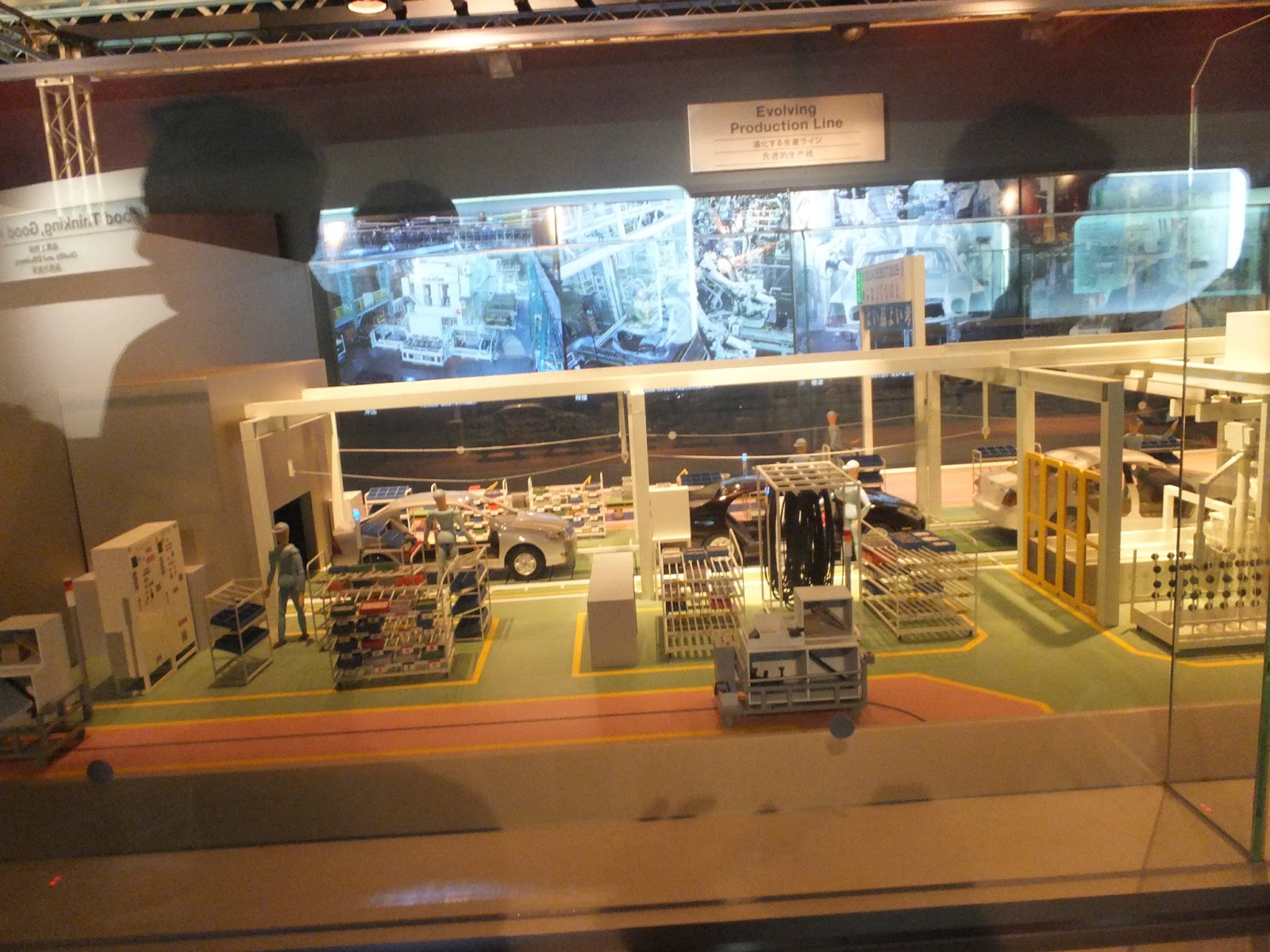
As we walked inside we could see various types of cars manufactured at Toyota factory - an ultra light weight concept  car  and the latest toyota and lexus models are also displayed here. Also we could see different environmental friendly models of Toyota which is getting common in the streets of Japan and an i - unit which will become popular in the coming future. A small structure of the car manufacturing steps is also reproduced  in this museum.


The museum.


A sports car.


The car engine displayed.


The manufacturing process inside the factory.


Sharp at 10.30am , we started our journey to Motomachi factory. There were two groups - the Japanese guided tour group were in another bus. The guide explained the peculiarities of the buildings seen at Toyota city and the manufacturing process inside the factory that we are going to visit . Also she explained about the history of Toyota. The history of one of the biggest car manufacturing companies which had grown into 51 branches worldwide in its 55 years of growth. The manufacturing process includes mainly 4 steps. 
1. Stamping - where steel sheets are cut and stamped to form the body parts.
2. Welding - where robots weld about 400 body parts to form the car.
3. Painting - the washed car body is painted by applying the undercoat, intermediate and the topcoats.
4. Assembly - This is the only place where all the works are done by people. Here engines, wheels an other parts are installed.
We visited the Welding  and the Assembly units of Motomachi plant.

After that we had to travel for 10 minutes to reach the welding unit of Motomachi plant. There the guide gave us an introduction about the models being manufactured there and the procedures. Once we reached there, I got really surprised seeing the number of different robots welding the various car parts , of multiple models. Each robot is welding four or five parts and the car is moved to the next robot and the process is going on without any delay. A world of robots - it was really interesting. I couldn't believe my eyes seeing the work done by the robots and the number of cars moving at every minute.


Welding unit.
We got only 30 minutes to watch the welding process and we were carried to the assembly unit. We traveled another 8 minutes to reach there. There also our guide gave us the overall concept of the work being done at this unit. There are different subunits inside. We moved forward through the platform raised  for the visitors above the working plant. It was really more unbelievable sight there than that we have seen at the former place. At the first place we saw the workers sorting and arranging the car parts and other accessories, so that they can be carried to their respective assembling places easily. There were small vehicles inside the unit inorder to transport these things to their respective sites. Then we reached the place where a number of cars were assembled with their doors, windows etc. where workers are placed in lines on both sides of a moving bar along which car are moving forward slowly. Along with the movement of the car, every worker has to finish his part of assembling process without any delay. And the workers were doing their job in a very speedy manner.


Assembling section.
The way these people work cannot be imagined by people like me. Its really amazing. Doing things in such a speedy manner is impossible without much practise. Every one is doing their part of job in the correct time alloted to them.Then we reached that section were the engines , batteries and similar accessories are assembled. After that, the section of assembling the window glasses and door glasses , lights and other things. There is arrangement inside the unit to give alert to the supervisors if any fault is found during the manufacturing process, so that they can pull a chain hanged aside and stop the movement of the bar and hence the vehicles. And the engineers will ceck and solve the issue quickly to start the assembling porcess soon. It happened many times as we walked through this unit at various places. And this sort of issues are not at all causing any time delay for the entire operation.  At the end, we could see hundreds of cars that are manufactured there moving to their testing unit where they check the entire vehicle. 

The bus returned us to the place where we started our journey - at the headquarters of Toyota.

Wednesday, June 13, 2012

Cherry blossom at Togokusan Fruit Park, Kozoji..

We planned to go to the Togokusan Fruit Park during the cherry blossom. We went there on one Sunday. Eventhough the overall weather is cold, that day was sunny. So the journey was quite comfortable for us. From Tajimi we reached the very next station ,  Kozoji and walked to the park. Kozoji is a quite big place and the roads were very rushed.  We crossed a bridge over the river. We saw some bamboos felt down in the river  due to last night's rainfall and wind. There was a heavy crowd on the road and we scared that  it will be difficult if it is too rush there in the park. On midway, half of the people went to another way as they came for sawayaka walking. We alked for about 15 minutes, but slowly as it was crowded. At last we reached the park. There were so many sakura trees seen on the way to the park and the park looked pink in color from outside. It as the Hanami day in the place, that is why such a large crowd is seen there. "Hanami" is the Japanese practice of picnicking under blooming sakura trees. 
Map of the park.

 There were various varieties and colors of Sakura in this park. Also there are other kinds of colorful floers in the park like tulips, poppy etc. There as a small pond with sakuras and other  trees around it which seems so beautiful. While walking through the park, we saw the fruit trees of the park, but the leaves have just sprouted after the winter season. 

We saw a man standing on a board lifted over a roller wood and playing balls.  We stayed there and watched it for some minutes. It was amazing.
Man playing balls over a roller.

At another part of the park, we saw a lady with a monkey playing some tricks. There were such small shows conducted at some corners of the park.

Monkey playing tricks in the park.
We walked towards the lake, crossing the bridge e entered the lake bank here a lot of people spend time on fishing. At this place you can rent fishing rods and buy food for them. There we saw so many people fishing, we observed some of them for some minutes, but couldn't ind any fishes getting trapped in their tray, eventhought hey take over the food from the rod.

A rose sakura on the lake bank.

Sakuras on the bank of the lake.

Me on the bridge.

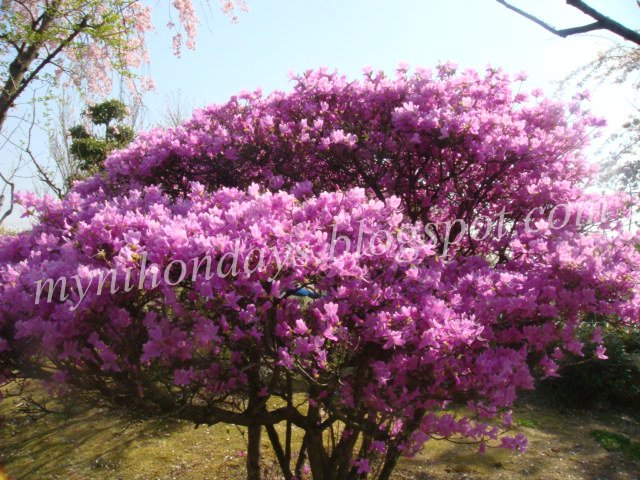
White sakura.

A variety sakura with more petals and different color.

The yellow flowers beneath the sakura trees.


A fountain in the lake.


The greenhouses.
 There were two green houses inside the park where they grows tropical fruits. Inorder to enter inside we have to take a ticket worth 200 yens per person. There are trees like jack fruit, mango etc that are very common in our place. Felt like we are in a village of Kerala. There  are spiral steps up inorder to see the trees and plants inside the green house.


As we walked back, we bought some Takoyaki from the small snack house where they prepare some items  there itself.

Takoyaki.
After eating our Takoyaki, we walked to the fruit stall of the park. It was crowded with people. Since it is the strawberry season, packets of strawberries ere sold in front of the stall. We went their for buying a pack, but seeing the long queue we stepped back. But we entered the stall and buy some dry fruits and sweets from there. 

A colorful sakura on the way.


Nagoya Castle.

From Fushimi station, we reached the Kamimaezu station via Tsurumai line and changed to  Meijo Subway Line to reach the Shiyakusho Station. While walking from the station we saw the Nagoya City hall.

Nagoya City Hall
Nagoya city hall.

It was built in 1933 and miraculously survived the wartime bombing of the city, which destroyed nearby Nagoya Castle.The building is a mix of Japanese and western styles and includes the imperial symbol at the top of its roof. The tower (pictured below) has 12 floors.
The complex contains many of the administrative offices of Nagoya city including the Mayor's office, the Health and Welfare Bureau, the Fire Department, the Board of Education Office and the Office of Tourist Development.

We reached to the castle's east gate in three minutes. We decided to have our lunch before entering the castle. We found a small park near to the castle compound and ate our food that we had with us. The park seems like not a popular one. Apart from all other parks that I had seen in Japan till now, this park is not so well managed. There were nobody else in the park than us and to kids practicing their first lessons of cycle riding from their parents.

After finishing our lunch, we reached the entrance of the castle from there we bought our entrance tickets.

Entrance ticket of the castle.


Flower in the garden.
 There was a beautiful garden on one side of the path towards the castle. We walked through the garden or 20 minutes.Also we saw some small drama played at one side of the wide path. We stayed to watch it for some time. But I couldn't understand what they are saying. Two of them were dressed like warriors and from their action I got the idea that one of them is teaching the other man how to use the sword for fight.


Drama played inside the castle compound.

Statue of Kato Kiyomasa inside the castle area.
Nagoya Castle - History
Nagoya Castle was constructed on the orders of Ieyasu TOKUGAWA in order to secure an important position on the Tokaido road and to ward off attacks from the direction of Osaka. Construction was completed in 1612, and the castle is typical of those built on flatlands. Until the Meiji Restoration, Nagoya Castle flourished as the castle in which the Owari lineage of the Tokugawa family, the foremost of the family’s three lineages, resided. In May 1945, during the air raids on Nagoya in the Second World War, most of the buildings including the main and small dungeons, and the Hommaru Palace, were burned down. Fortunately, however, three corner towers, three gates, and most of the paintings on the sliding doors and walls in the Hommaru Palace survived the fire, and have been handed down as Important Cultural Assets.


Nagoya Castle.


The castle has seven floors with greenish roof . There is an observation deck at the last floor. There is pair of stairs to reach there - one or climbing up and other for getting down.
All the floors are exhibited with various things of historical importance for the Nagoya Castle.Walking through all the floors, we can learn the entire history of the castle.
The first floor has a golden dolphin,  replica of the Ogonsui Well etc.
Remains of gold water well.
Kinshachi.

 Kinshachi
The best-known items associated with the Nagoya Castle are the golden dolphins, or kinshachi. It is said that the first dolphins (shachi) to adorn the main ridge of castle roofs, added when the basic construction of the castle was completed, appeared in the Muromachi Era (1334-1400) as symbol of the feudal lord’s authority. Although Nagoya’s golden dolphins shared the fate of the dungeon, being consumed by flames in the Second World War, they reappeared along with a rebuilt dungeon, in 1959, to the delight of the people of Nagoya.
 The next floor exhibits some important cultural assets that used to decorate the Hommaru Palace as well as swords and their accessories that were privately endowed.

Swords.
There were so many paintings exhibited there. Tigers, wild cats, pheasants, peacocks, cherry blossom etc. were among them. They were painted on the Japanese style sliding wooden walls.


 The castle town has been reproduced in the hall of next floor along with the architectural details. There were reproduced structures of various Japanese houses found here. Also  the structure of various rooms inside the castle and the life of lord and his town people are exhibited.  Armor, helmets, swords, and harquebus from the Nagoya Castle collection are displayed in another floor.

The castle area structure.

Hommaru palace model


Structure of Nagoya castle .
 The next floor have a seat on a full-scale replica of the Golden Dolphin and we can take photographs sitting there. We can also try pulling a rope tied to a stone for the Stone Wall. There are three people pulling big rocks which has been used for the construction of the castle.


People pulling the rock.

At last we reached the Donjon observation deck  from which we can view the Nagoya Castle grounds and outer lying areas including downtown Nagoya unobstructed by any high-rise downtown buildings. 

View from the Donjon observation deck.
Also there are small shopping centres too with a lot of unique things. A very basic peculiarity of the shops of Japan that I noticed is the things available at shops associated one place will not be available anywhere else.
 

On our way back, we spend some time  in the famous Ninomaru Garden of Nagoya Castle which is situated near the east gate.It is a traditional Japanese garden.

Ninomaru Garden.
The Ninomaru Garden was laid out between 1615-1623 along with the Ninomaru Palace. The garden was transformed into a strolling garden with grass lawns and dry stone gardens in the early 18th century.


Tuesday, June 12, 2012

Osu Kannon

After visiting the Atsutha Shrine, we reached Kamimaezu station and changed to Tsurumai Line. From there we catch our train to Fushimi. The Osu kannon temple is a Buddhist temple right outside of the subway station . It was about 1.30 pm when we reached there. 

Osu kannon temple

The Osu Kannon temple has a shrine of Kanzeon-bosatsu or kannon-sama and is worshipped as the Japanese goddess of mercy. Sculpted by kobo-daishi, a priest of the Heian era, the image of Kanzeon-bosatsu draws numerous visitors to its grounds. The image is eloquent with a benign smile carved on it, and is indeed an embalming sanctum for the worshippers here. A number of exquisite Buddha images line close to the main image .

Nagoya Osu Kannon had originally been built in the Gifu Prefecture, on the banks of the Kiso and Nagara River and served as a strategic point in the fortification of the main Tokugawa fort. However, a devastating flood in 1605 swept away the ancient structure, and all that remained were a few scriptures and other treasures. Tokugawa Ieyasu later housed these remains in the new temple that was constructed in 1612 in the site where it stands till date. The present building however, is a 1970 reconstruction, as the old structure had fallen prey to the ravaging flames that destroyed the main building and its adjacent pagoda in the 1820s. The reconstructed temple closely resembles the original construction and stands today to narrate a fascinating history.

The temple grounds draw a huge crowd to marvel at the colorful architecture, and the number of visitors multiplies as the temple grounds host its monthly flea markets. On the 18th and 28th of each month, the precincts of Osu Kannon are transformed into a bustling hub of shops supplying a variety of souvenirs and interesting oriental pieces. 

Osu Kannon temple

The temple looks so cute with its red color and a number of steps upto the Budha statue. There is a bell housed near to the temple. Also we saw a lot of small Budha statues at the foot of the temple steps.

The bell house.
Some small statues of Budha
at the foot of the temple.


There were a lot of shops seen near to the temple. We walked through the streets for half an hour and returned to the station.  

The shopping center near the temple.