Showing posts with label castle. Show all posts

Thursday, June 21, 2012

Nijo castle, Kyoto...

We started our journey at 7.30 am after checking out our rooms near the Kyoto station. The Kyoto tower looks different in the day light.


We took a one day pass to travel in the kyoto city and started our way to Nijo castle via bus.


Nijo Castle.
 It was not allowed to take photographs inside the castle. The admission ticket worth 600 yens.
Entry ticket for the castle.
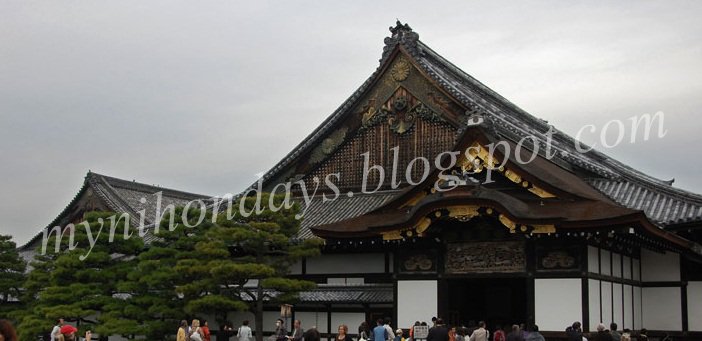
                After entering on the right there is a guard house with mannequins dressed as samurai guards. Following the wall around will bring you to the Kara Mon (Chinese Gate) which is the entrance into the Ninomaru Palace. Decorated by cranes, flowers, and butterflies on the outer panels and Chinese tigers,  lions and a dragon on the inner panels this gate is a splendid sight. 

At the entrance of Ninomaru Palace.
                  After walking through the Kara Mon we reached the main complex of Ninomaru Palace . The Carriage  Porch (Karuma Yose) is followed by the Tozamurai. It was in this building that visitors would wait for an audience  with the shogun. The next building is called Shikidai, followed by Ohiroma where several mannequins in traditional garb, sitting in on an audience with the shogun. The next building is connected to Ohiroma by a long chamber, Kuro-shoin, which was reserved for the friends and family of the shogun.  The last building, Shiro-shoin, was the shogun's residence, where only his wives and concubines were allowed.
                The shoin-zukuri style reflects the social heirarchy within the feudal period of Japan. The higher ranking and more distinguished a guest was, the further they got into the compound. Moreover, their position allowed them to be on a higher floor level. Each building has a slightly higher floor than the previous building, reflecting the social status of the guest. However, each building also had a raised platform on which the shogun would be seated during an audience so no one's head was higher than his.
              While entering in, beautiful sounds emanating from the floor can be heard.  This is called 'uguisu-bari' and was intended to protect the occupants from sneak attacks and assassins. The builders constructed the floors of the corridors in such a way as to squeak like birds when anyone walks on them. When we enter the ninomaru palace, we could see the emotionally-moving wall and sliding door paintings which all are really amazing.It includes paintings of nature,  birds etc.
             The Ninomaru garden is one of the main attractions of this place which is really wonderful with waterlilies, plants, and rocks. In the center of the garden is a large pond containing three islands connected by four bridges.

The pond of the Ninomaru Garden.
It was really a wonderful site of new experiences in this castle.


Wednesday, June 13, 2012

Nagoya Castle.

From Fushimi station, we reached the Kamimaezu station via Tsurumai line and changed to  Meijo Subway Line to reach the Shiyakusho Station. While walking from the station we saw the Nagoya City hall.

Nagoya City Hall
Nagoya city hall.

It was built in 1933 and miraculously survived the wartime bombing of the city, which destroyed nearby Nagoya Castle.The building is a mix of Japanese and western styles and includes the imperial symbol at the top of its roof. The tower (pictured below) has 12 floors.
The complex contains many of the administrative offices of Nagoya city including the Mayor's office, the Health and Welfare Bureau, the Fire Department, the Board of Education Office and the Office of Tourist Development.

We reached to the castle's east gate in three minutes. We decided to have our lunch before entering the castle. We found a small park near to the castle compound and ate our food that we had with us. The park seems like not a popular one. Apart from all other parks that I had seen in Japan till now, this park is not so well managed. There were nobody else in the park than us and to kids practicing their first lessons of cycle riding from their parents.

After finishing our lunch, we reached the entrance of the castle from there we bought our entrance tickets.

Entrance ticket of the castle.


Flower in the garden.
 There was a beautiful garden on one side of the path towards the castle. We walked through the garden or 20 minutes.Also we saw some small drama played at one side of the wide path. We stayed to watch it for some time. But I couldn't understand what they are saying. Two of them were dressed like warriors and from their action I got the idea that one of them is teaching the other man how to use the sword for fight.


Drama played inside the castle compound.

Statue of Kato Kiyomasa inside the castle area.
Nagoya Castle - History
Nagoya Castle was constructed on the orders of Ieyasu TOKUGAWA in order to secure an important position on the Tokaido road and to ward off attacks from the direction of Osaka. Construction was completed in 1612, and the castle is typical of those built on flatlands. Until the Meiji Restoration, Nagoya Castle flourished as the castle in which the Owari lineage of the Tokugawa family, the foremost of the family’s three lineages, resided. In May 1945, during the air raids on Nagoya in the Second World War, most of the buildings including the main and small dungeons, and the Hommaru Palace, were burned down. Fortunately, however, three corner towers, three gates, and most of the paintings on the sliding doors and walls in the Hommaru Palace survived the fire, and have been handed down as Important Cultural Assets.


Nagoya Castle.


The castle has seven floors with greenish roof . There is an observation deck at the last floor. There is pair of stairs to reach there - one or climbing up and other for getting down.
All the floors are exhibited with various things of historical importance for the Nagoya Castle.Walking through all the floors, we can learn the entire history of the castle.
The first floor has a golden dolphin,  replica of the Ogonsui Well etc.
Remains of gold water well.
Kinshachi.

 Kinshachi
The best-known items associated with the Nagoya Castle are the golden dolphins, or kinshachi. It is said that the first dolphins (shachi) to adorn the main ridge of castle roofs, added when the basic construction of the castle was completed, appeared in the Muromachi Era (1334-1400) as symbol of the feudal lord’s authority. Although Nagoya’s golden dolphins shared the fate of the dungeon, being consumed by flames in the Second World War, they reappeared along with a rebuilt dungeon, in 1959, to the delight of the people of Nagoya.
 The next floor exhibits some important cultural assets that used to decorate the Hommaru Palace as well as swords and their accessories that were privately endowed.

Swords.
There were so many paintings exhibited there. Tigers, wild cats, pheasants, peacocks, cherry blossom etc. were among them. They were painted on the Japanese style sliding wooden walls.


 The castle town has been reproduced in the hall of next floor along with the architectural details. There were reproduced structures of various Japanese houses found here. Also  the structure of various rooms inside the castle and the life of lord and his town people are exhibited.  Armor, helmets, swords, and harquebus from the Nagoya Castle collection are displayed in another floor.

The castle area structure.

Hommaru palace model


Structure of Nagoya castle .
 The next floor have a seat on a full-scale replica of the Golden Dolphin and we can take photographs sitting there. We can also try pulling a rope tied to a stone for the Stone Wall. There are three people pulling big rocks which has been used for the construction of the castle.


People pulling the rock.

At last we reached the Donjon observation deck  from which we can view the Nagoya Castle grounds and outer lying areas including downtown Nagoya unobstructed by any high-rise downtown buildings. 

View from the Donjon observation deck.
Also there are small shopping centres too with a lot of unique things. A very basic peculiarity of the shops of Japan that I noticed is the things available at shops associated one place will not be available anywhere else.
 

On our way back, we spend some time  in the famous Ninomaru Garden of Nagoya Castle which is situated near the east gate.It is a traditional Japanese garden.

Ninomaru Garden.
The Ninomaru Garden was laid out between 1615-1623 along with the Ninomaru Palace. The garden was transformed into a strolling garden with grass lawns and dry stone gardens in the early 18th century.


Friday, June 8, 2012

Gifu Castle...

May 5th, Its the third holiday of the Golden week and we planned to visit the Gifu Castle. We have two options to reach there by train - either we can go to Nagoya and from there catch another train to Gifu or directly from Tajimi station to Gifu. If we opt the first one,  we will reach Gifu some 20 minutes earlier than the second. But the fare is 1110 yens in total. The second way will take 72 minutes to reach there while the fare is 820 yens. Considering the cost and the benefit that we can reach there in a single train, we opted the latter. From Tajimi, we started our jouney via Taita line. The train had only two bogies and the passengers are also less in number. That might be the reason why there is not much services through this line while comparing with the others.
  Out of the Gifu station as a beautiful park with fountains , flowers and trees surrounding the Golden statue of Nobunaga Oda.


Park outside Gifu station.


Golden Nobunaga Oda Statue.


With the `samurais
From the eki, we caught a bus and reached in front of the Gifu park (`Gifu koen maye`). We walked up to the entrance of the park located at the base of Mount Kinka. At the entrance, there is a statue of Nobunaga Oda riding a horse. Inside the park was so beautiful with trees all around and a pool with colorful fishes swimming around. There was a small bridge across the pool and a beautiful waterfall made at one end of the pool. We wandered around through the park and saw some people dressed like samurais for entertaining the visitors of the park. We took photos with them. At one end of the park, there was a beautiful fountain with a statue at the center. 

Small bridge.


Fountain in the park.
 After about 25 minutes of walk through the park taking some photos and enjoying the beauty of nature there, we walked up through the trails to reach the three- storied pagoda. The vermillion tiered tower is surrounded by green trees. It is located in the moutainside easy of the Park. The majestic appearance in its red color vividly draws attention from afar.  

Three - storied pagoda.


Kinkasan ropeway pass.
Cable car of the Kinkasan Ropeway
 As we reached infront of it, we saw that the entrance to the pagoda is closed. We got disappointed as we walked up through the trails for a 10 minutes to reach up there. We walked down to the ropeway base station, Sanroku located inside the park. From there cable car services are offered up to the mountaintop of Kinka here situated the Gifu castle. We bought two round trip tickets from there which costs 1050 yens per person. After waiting for a 10 minute, we entered the cable car. This is my first ropeway ride and am a bit scared while the car moved up. The site as so nice as  we could see the thick tree tops and the red pagoda along with the Gifu city while moving up.
Pagoda view from inside the cable car
 But the ride was too short and e reached the summit Sanch station in 3 minutes. We have to walk along a paved path to reach the Gifu castle. After passing the first gate - Tenka Daiichi-no-mon gate, started the steps up to the castle tower. 


Tomb on the way to castle
A structure on the side of the pavement.
After walking some more distance we saw another gate - the Ninomaru gate. Then we reached a place from where we get a very nice view of the castle.


Castle tower as viewed from at a place along the pavement.
After a 40 minutes walk from the station we reached the castle entrance. We both got a little tired as we reached the top. We spent a 10 minutes over the rocks in ront of the castle. After that took the entry pass for the castle orth 200 yens per person and walked in. 


Gifu castle entrance ticket
 There are four floors for the castle of with an observation deck at the top. The first  floor exhibited weapons like  bows and arrows, muskets, swords, spears, rifles etc.


Swords.


Spears.


Swords.


Bows and arrows.
The second floor of the castle has paintings of the people occupied in that palace including Nobudaga and his wife..


Nohime - Nobunaga`s wife
Oda Nobunaga


Oda Nobunaga.
Saito Yoshitatsu
Saito Dosan
 The third floor - Nobunaga room exhibits the statues, armor suits, helmets, telescopes, lenses, maps etc. of Nobunaga`s period(Edo period) .


Oda Nobunaga`s statue.
Eyeglasses.


Armor suits and helmets.
 At last we reached the forth floor, the observation deck which provides a grant panoramic view of Giu city including the Nagaragawa(`gawa` means river). There are telescopes arranged at the four corners or enjoying the view hich e can use by paying a 100 yen.


A view of Nagara river from the observation deck.


Some photos taken from the observation deck of Gifu castle.
After spending 20 minutes there, we walked down the stairs and reached the round floor. There we found a rest corner for the visitors here e sat for a 15 minutes. The television there displayed the Nagaragawa festival which is a fishing festival held in the Nagara river.

While walking down to the ropeway station, we entered the Gifu castle museum which displays armors, robes etc of Edo period. On the way down, there was a well  named Honmaru well (The well of Gifu castle) which was used for military purposes.
 
Honmaru river.
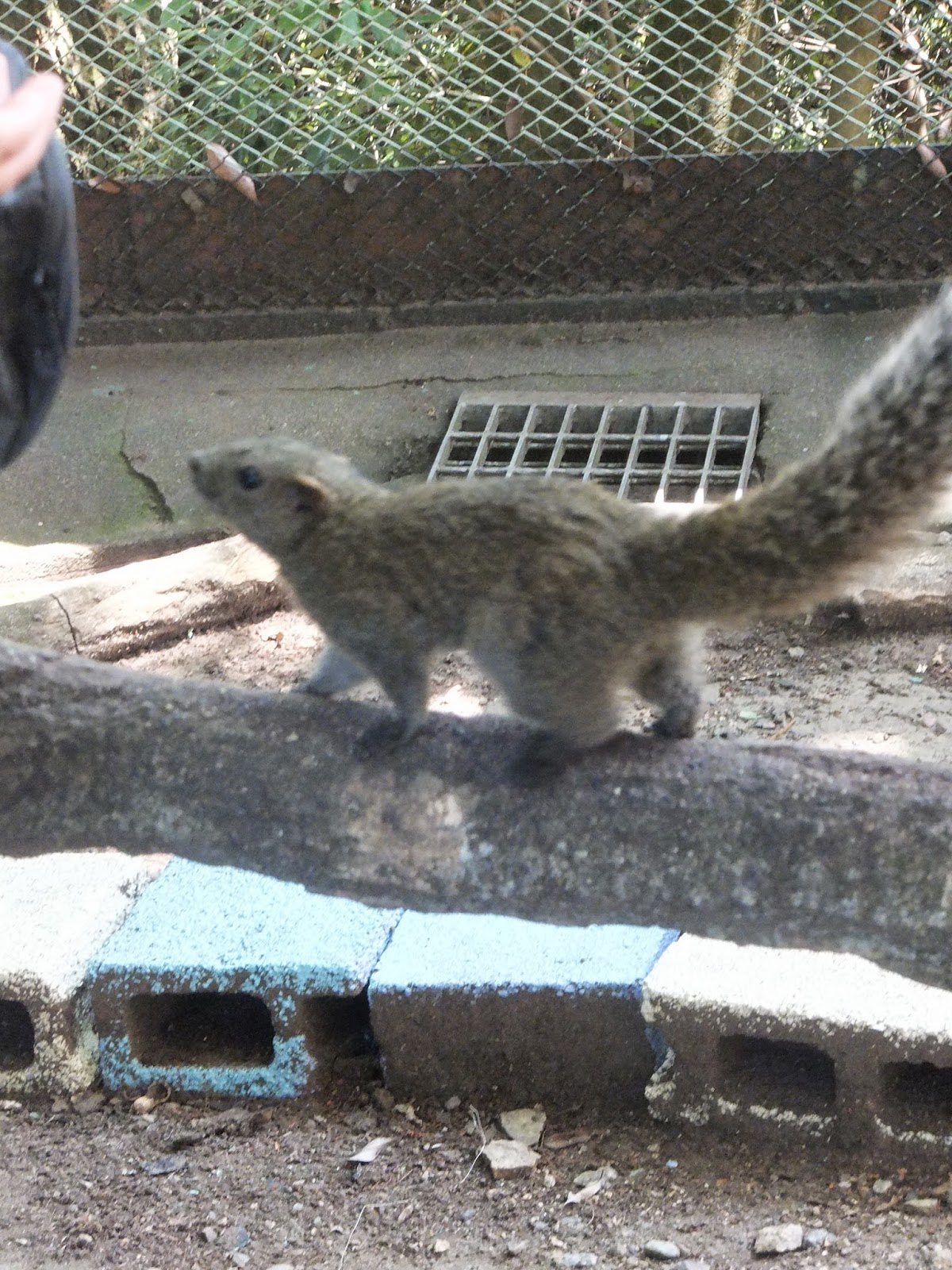
 Near to the ropeway station, there is a squirrel village here they keeps various varieties of squirrels. Visitors are allowed to feed them too. We get inside after taking an entry pass worth 200¥. They gave a glouse to wear and some powder was placed on our covered hands so that the squirrel will come to us. Once the grain flour is over, they went away fast. I love squirrels, but the squirrel village disappointed me. There are some rabbits also inside the village.


Then we returned back to the mountain foot. After spending some 30 minutes in the Gifu Park, we walked towards the bus stop Gifu koen maye.