Showing posts with label nagoya. Show all posts

Sunday, March 22, 2015

Umematsuri at Oo-Agata(Himenomiya) Shrine of Inuyama

           
                We visited the Oo-Agata Shrine during the Ume-matsuri (plum festival) on March 21,2015 and the entire plum trees were flowered by the time. 


                  There were a wide variety of plums from all over Japan with different colour shades : White, Pink and Rose being the dominant. The view of small mountain behind the shrine covered with plum trees of different colours is really exciting. 


                         The steps to the top of the mountain and the small pavements were adorned with the flower petals by the wind. The breeze seems charming when it showers over us the tiny petals to welcome us. The site form the top is still more interesting and couldn't feel like getting out of there leaving such a beautiful place. Since the winter has just leaved, the slightly cool breeze and the warm sun rays provided a better climate that allowed us to spend much more time over there without any problems. Everyone seems really enjoying the breeze as it showers a petal  'rain'. 


                      Oo agata is believed as the goddess of wedding and childbirth. The wooden wishing plaques(ema) of this shrine were written the wish for a child or better married life.


                    The shrine had a lot of visitors and hence a lot of small souvenir shops including a small plant and fruit stall. There was some grant event called Oagata Jinja Hohnen-sai(Harvest festival) held on March 15th every year and this year's had just done last week. There were still some rituals and programs being conducted there.


After spending some time infront of the shrine, we waited at the place arranged or some event ithout knowing when or hat is going ton there. The seats arranged there were simply awesome. We sat there for some 30 minutes. As there is nothing happening till then, we decided to return.

Wednesday, February 18, 2015

Nabana no Sato (なばなの里)


Dec 28,2014

                      We decided to go for the winter illuminations of  Nabana no Sato. As we checked for the bus timings from Nagoya, it seemed convenient but on searching for the train timings and the fare, we could find that the cheapest one is the JR. There is another line bound to Nabana no sato called the Kintetsu line. But JR seems cheapest and we decided to take JR. Arriving at the Nagashima Station, which is a small one without any ticket checking system too, we walked to the bus station near Kintetsu Station which is only some 5 minutes of  walk. Fortunately, we were able to get inside the first bus that started from there upon our arrival. The bus was bound for Nabana no Sato.

                      The lighting starts at 5 pm only, but it was already crowded when we reached there at 4:15 pm. Taking the entry tickets worth 2000yen, we get inside. The  entry actually costs only 500 yen, but the rest amount was given as the coupons that can be used for shopping inside the Nabano no Sato.  


 As we had more than half an hour, we decided to use our first coupons for a Yakisoba. It was really interesting to watch the three Yakisoba cooks. They were saying "Oishiku nare, Oishiku nare" while making the Yakisoba. It exactly cost our single coupon of 500 yen, we both have another two coupons each for further shopping inside. After enjoying our Yakisoba, we walked around nearby the entrance itself. 


      There was a round observation deck, like a mushroom, which is rotating all around the illumination area. Eventhough we decided to enter it once the illumination starts, we couldn't do it because of the heavy crowd that arrived after 5pm.


       At 5pm, the bell rung and the lights were turned on. There are no words worth to describe the feeling when we were surrounded by lights all around. Different colors,different shapes, camera flashes all around, and can't make an  approximate  count of the people present there. The crowd moved like a flowing river, without any end. We also joined them. The rest , I could only describe with the snaps that follows.


                    And at last we were guided through a tunnel full of lighting and that 10-15  minutes of walk made us to think that we were becoming part of a fairy tale. There is no opportunity for us to make a click peacefully, due to the crowd.


                     At last, it was a show of some 15 minutes, the Nayagra falls, with lakhs of LED. It was amazing, as we couldn't believe it was all the tricks done with light. The flowing Nayagra, in different illuminations, birds flying across the falls. And the falls during winter when it seems to sleep solidified. We watched four times, through four different directions, each of which provided different experience for us. There is an observation deck to view this show from where we can enjoy the beauty of illuminated falls at its peak.  


               While returning after the Nayagra waterfalls show, there was another small tunnel of lighting, which was greenish(leaves) with some flowers in between them.


               It started raining by that time and we get inside some shop, used our coupons for some souvenirs  and hired the next bus to Nagashima for the JR train.

Tuesday, June 12, 2012

Osu Kannon

After visiting the Atsutha Shrine, we reached Kamimaezu station and changed to Tsurumai Line. From there we catch our train to Fushimi. The Osu kannon temple is a Buddhist temple right outside of the subway station . It was about 1.30 pm when we reached there. 

Osu kannon temple

The Osu Kannon temple has a shrine of Kanzeon-bosatsu or kannon-sama and is worshipped as the Japanese goddess of mercy. Sculpted by kobo-daishi, a priest of the Heian era, the image of Kanzeon-bosatsu draws numerous visitors to its grounds. The image is eloquent with a benign smile carved on it, and is indeed an embalming sanctum for the worshippers here. A number of exquisite Buddha images line close to the main image .

Nagoya Osu Kannon had originally been built in the Gifu Prefecture, on the banks of the Kiso and Nagara River and served as a strategic point in the fortification of the main Tokugawa fort. However, a devastating flood in 1605 swept away the ancient structure, and all that remained were a few scriptures and other treasures. Tokugawa Ieyasu later housed these remains in the new temple that was constructed in 1612 in the site where it stands till date. The present building however, is a 1970 reconstruction, as the old structure had fallen prey to the ravaging flames that destroyed the main building and its adjacent pagoda in the 1820s. The reconstructed temple closely resembles the original construction and stands today to narrate a fascinating history.

The temple grounds draw a huge crowd to marvel at the colorful architecture, and the number of visitors multiplies as the temple grounds host its monthly flea markets. On the 18th and 28th of each month, the precincts of Osu Kannon are transformed into a bustling hub of shops supplying a variety of souvenirs and interesting oriental pieces. 

Osu Kannon temple

The temple looks so cute with its red color and a number of steps upto the Budha statue. There is a bell housed near to the temple. Also we saw a lot of small Budha statues at the foot of the temple steps.

The bell house.
Some small statues of Budha
at the foot of the temple.


There were a lot of shops seen near to the temple. We walked through the streets for half an hour and returned to the station.  

The shopping center near the temple.

Atsuta Shrine

From Sakae, we changed to Meijo line and reached the Jingu Nishi station. From the station we walked towards the Astuta Shrine. The busiest roads of the city  looks so beautiful with the pink, rose and white flowered bushes on its both sides.

The roads of Jingu-Nishi.


We have to walk a 10 minutes to reach infront one of the wooden gates of the Shrine .

The Shrine gate.
 The shrine was placed in a large wooded area that had city pretty much surrounding it on all sides.
The pavement inside the shrine.

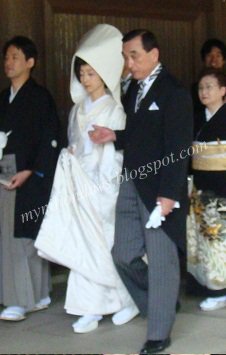
A bride seen in between the woods.
We walked forward and reached a place with raised stone trough of cool water with wooden ladles laid upside down on a rack over the water.  I have seen this earlier in Toganji temple at Nara. My husband who had went there with his Japanese friends earlier knew that it was for washing our feet and palms before entering the temple.  There were nobody around us while we did it at Nara. We don't actually know the right procedure to use the laddle. There are a lot of people around the trough. We waited for sometime to watch what people are doing there. They take a ladle and pour water over their hands, one at a time, some would rinse out their mouths as well, then replace the ladle and dry their hands. It resembled our culture of washing feet and hands in temple ponds before entering inside.

About Atsuta shrine

Atsuta is the second among the venerable shrines of the country.  It is devoted to Amaterasu, ( the Sun Goddess), and the Kusanagi no mitsurugi sword placed in the shrine is revered as one of the three Imperial regalia of the country. 

Atsuta houses one of the three Imperial regalia of Japan given to the ruling family by Amaterasu – the sacred sword Ama-no-Murakumo-no-Tsurugi (“Sword of the Gathering Clouds of Heaven”), later renamed Kusanagi-no-Tsurugi (“Grasscutting Sword”) after its possessor, Yamato Takeru, used it to escape death in a burning field by cutting a space in the surrounding grass. The sword is said to control the winds, and Yamato used it to direct the winds to blow the fire back at the treacherous lord who had set the field afire. (The other two Imperial regalia are a mirror, housed at the Grand Shrine at Ise, and a jewel, housed at the Imperial Palace in Tokyo.)
 
Only a few highest priests are permitted to see the sword.The sword is believed to belong to the storm god Susanoo, and was passed on to the legendary hero Yamato-takeru who waved away the flames with his sword. Atsuta houses an enchanting collection of about four thousand artifacts that manifest the richness of ancient culture. Nearly seventy festivals are hosted here each year, and the shrine attracts numerous tourists to savor the richness of ancient traditions.  One of the most popular festivals celebrated here is the Eyoudo ceremony in which the Shinto priests march around the shrine laughing and chanting.

We heard  some musical instruments being played. There was some Japanese traditional danceform performed there along with musical instruments like drum, flute etc. There were four girls with a fan in one hand and some sort of stick in their other hand moving them in rhythm with the music. We watched it for sometime and walked towards the building where the great sword is kept.

In front of the shrine.
 We found a large structure with a fence in front of it. People were stand in front of the fence, bowing, throwing coins into a box on the other side of the fence and then clapped twice and again bowing. We observed them and did like that.
The building where the sword is kept.
Once we stepped out of there, we saw a bride and groom walking towards the shrine. We stayed there watching them for a while and they started worshiping. 


We went near the stage and once more watched the dance form , but now some more people have joined the girls on the stage with their flutes.


We walked towards the gate of  the shrine and saw some other buildings there.


There as a temple at the left of the shrine gate. We just entered there, but e couldn't find much people here eventhough there were many inside the shrine. We left there in 5 minutes and walked towards the station.

Temple near the shrine gate.